
Tsiology
In 1826, a small book was published in London bearing the curious name Tsiology; A Discourse on Tea. Like many previous treatises written in Europe, Discourse dealt with the nature of the exotic Asian plant Camellia sinensis and its leaf. Yet, no title on the subject of tea was ever so strange as Tsiology.
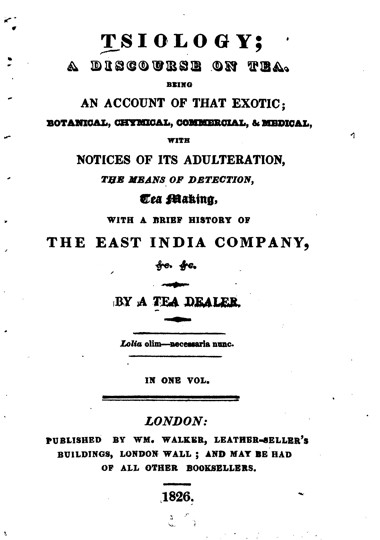
Tsiology; A Discourse on Tea
Lengthy subtitles provided the content of the book: “being an Account of that Exotic; Botanical, Chymical, Commercial, & Medical, with notices of its adulteration, the means of detection, Tea Making, with a brief history of The East India Company, etc.”[1] But the word “tsiology” was still difficult to fathom, and parsing the term merely hinted at a special branch of knowledge or science.
“Tsiology” defied discovery in the dictionaries of the day, but its exclusion from the English lexicon was easily explained: the word was pure invention. Expressly coined for the book, “tsiology” appeared just once in the title and not at all in the text,[2] leaving the origin and true meaning of the term a profound mystery. That the author, “A Tea Dealer,” remained cloaked in anonymity further muddled the matter.[3]
Nonetheless, Tsiology briefly intrigued London readers with its veneer of erudition, the novel work and title lasting through three editions printed over a year or so.[4] Although the book dealt with several important and timely issues of the British tea trade, “tsiology” never gained popularity as an expression of tea, and indeed it all but disappeared from the common English language.
Notes
[1] The full title of the book read Tsiology; A Discourse on Tea, being an Account of that Exotic; Botanical, Chymical, Commercial, & Medical, with notices of its adulteration, the means of detection, Tea Making, with a brief history of The East India Company, etc. For a list of early books on tea, see John Coakley Lettsom (English, 1744–1815), The Natural History of the Tea-Tree (London: Edward and Charles Dilly, 1772), pp. 8-12. George van Driem, Professor Emeritus at the University of Bern, noted that Tsiology was a second generation plagiarisation of The Tea Purschaefer’s Guide of 1785; the first plagiarisation of the Guide being The London Genuine Tea Company of 1820. See George van Driem, The Tale of Tea: A Comprehensive History of Tea from Prehistoric Times to the Present Day (Leiden: Brill, 2019), chap. 11, p. 760, nos. 2 and 3.
[2] “Tsiology” was used as the title twice in the book: once on the half title page and then on the title page.
[3] For the attribution of authorship of the book Tsiosophy to William Smith, see Hoh-Cheung Mui and Lorna H. Mui, Shops and Shopkeeping in Eighteenth-century England (London, 1989), p. 353 and also Markman Ellis, Richard Coulton, Matthew Mauger, Empire of Tea: The Asian Leaf that Conquered the World (London: Reaktion Books, 2015), pp. 208 and 209.
[4] Alfred Rehder (American, 1863-1949), The Bradley Bibliography: A Guide to the Literature of the Woody Plants of the World Published Before the Beginning of the Twentieth Century (Riverside Press, 1915), vol. 3, p. 606.
Ode to Tea
壺蘆居士繙譯
Du Yü (ca. 282-311 A.D.) of the Western Jin Dynasty
Ode to Tea
On Mount Ling is a high peak where
a wondrous thing gathers.
It is tea,
filling the valleys and covering the hills,
moist with the wealth of the Earth,
blessed with the sweet spirit of Heaven.
In the first harvest moon,
the farmers get little rest.
Couples at the same task,
searching and picking.
Take water from the flowing river Min,
draw from its pure currents.
Select bowls from lustrous wares
produced in Eastern Ou.
Serve tea with a gourd ladle,
emulating the way of Duke Liu.
Only then can one begin to perfect
thick froth, afloat with the splendor of the brew,
glistening like piling snow,
resplendent like the spring florescence.
Chaste and true like new frost,
pure like the Void,
tea harmonizes the spirit, blending within,
languidly free, effortlessly Empty.
西晉杜毓
荈賦
靈山惟嶽
奇產所鍾
厥生荈草
彌谷被崗
承豐壤之滋潤
受甘靈之霄降
月惟初秋
農功少休
結偶同旅
是采是求
水則岷方之注
挹彼清流
器澤陶簡
出自東隅
酌之以匏
取式公劉
惟茲初成
沬沉華浮
煥如積雪
曄若春敷
若乃淳染真辰
色責青霜
白黃若虛
調神和內
慵解慷除
Primary source
Yiwen leijü 藝文類聚 (Encyclopedic Collection of Writings by Category, 624 A.D.), Ouyang Xun 歐陽詢 (557-641), et al., comps. , juan 卷 82, no. 1.9.