
The Orchid Pavilion Preface

眠雲臥石
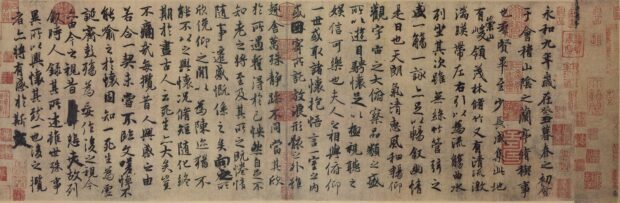
In the ninth year of the Yonghe reign, the guichou cycle, at the onset of the end of spring, we gather in Shanyin on Mount Kuaiji at the Orchid Pavilion for the purification ritual. Here the able and virtuous assemble, young and old, all gather. This place has lofty mountains and towering peaks, luxuriant woods and tall bamboo. Clear streams and surging rapids, set about on the left and right, entice all to sit and float cups in the flowing water. Although lacking the flourish of wind and silk strung instruments, a wine cup and a song are enough to express our deepest feelings. On this day, the sky is clear, and the air is fresh with a gentle, pleasant breeze. Looking up at the vastness of the universe, and down at the abundance of all things, we thus give eyes and mind free rein, exhausting the pleasures of sight and sound. Truly a delight! When bonded as friends, a lifetime seems to pass in an instant. Some care to converse closeted together, others deliver themselves to obsessions and indulge in unrestrained expression. Preferences infinitely differ, just as the serene contrasts with the cantankerous. Encountering pleasure and momentary gratification — a nonetheless dispirited self-satisfaction — we do not realize that dotage advances. When weary, and feelings change with circumstances, there is naught but sighs and regret. Former pleasures soon become things of the past. Even so, we cannot help but be moved by them. Whether long or short, life must change, for there is always an end. As the ancients said, “Death and birth are momentous!” How utterly bitter! With each reading of the causes of melancholy among those in the past, there is ever a resonance. In response, I find myself lamenting and unable to articulate my feelings. But I know for certain that equating life and death is a fallacy. and comparing a long life with a short one is a delusion. Those who come after will view us as we look upon those who came before. How tragic! And so, I record everyone present on this occasion and transcribed their verses. Although time and circumstance differ, the sentiments evoked are constant. May future readers be moved by this foreword.
Composed by Wang Xizhi, General on the Right of the Jin dynasty
永和九年嵗在癸丑暮春之初會于會稽山隂之蘭亭脩稧事也羣賢畢至少長咸集此地有崇山峻領茂林脩竹又有清流激湍暎帶左右引以為流觴曲水列坐其次雖無絲竹管弦之盛一觴一詠亦足以暢敘幽情是日也天朗氣清恵風和暢仰觀宇宙之大俯察品類之盛所以遊目騁懐足以極視聽之娛信可樂也夫人之相與俯仰一世或取諸懐抱悟言一室之内或因寄所託放浪形骸之外雖趣舎萬殊静躁不同當其欣扵所遇暫得扵己怏然自足不知老之将至及其所之既惓情随事遷感慨係之矣向之所欣俛仰之閒以為陳迹猶不能不以之興懐况脩短随化終期扵盡古人云死生亦大矣豈不痛哉每攬昔人興感之由若合一契未嘗不臨文嗟悼不能喻之扵懐固知一死生為虛誕齊彭殤為妄作後之視今亦由今之視昔悲夫故列敘時人錄其所述雖世殊事異所以興懐其致一也後之攬者亦将有感扵斯文
晉右將軍王羲之
Figure
Wang Xizhi 王羲之 (303–361)
Lanting ji xu 蘭亭集序 (Orchid Pavilion Preface, 353)
Shenlong ben 神龍本 (The Shenlong version, 639) by Feng Chengsu 馮承素 (617–672), attributed
Palace Museum, Beijing
Note
Jinshu 晉書 (Book of Jin, 648), juan 80, lieh juan 50, p. 4a. Compiled by Fang Xuanling 房玄齡 (579–648) and Chu Suiliang 褚遂良 (596–658). SKQS.
Comparative translations:
Lin Yutang, The Importance of Living (New York: Reynal and Hitchcock, 1937), pp. 156–158.
Hsin Chang Chang, Chinese Literature: Volume Two: Nature Poetry, (Edinburgh: Edinburgh University Press, 1977), pp. 8–9
Marshall P.S. Wu, The Orchid Pavilion Gathering: Chinese Painting from the University of Michigan Museum of Art, (Ann Arbor: Regents of the University of Michigan, 2000), vol. 1, cat. no. 17, pp. 104–109 and vol. 2, cat. no. 17, ns. 1–22, pp. 43–46.
K.S. Vincent Poon and Kwok Kin Poon. English Translation of Classical Chinese Calligraphy Masterpieces. Toronto, 2019, pp. 46–50.