
Spring of the Instructor: Wenxüe qüan 文學泉
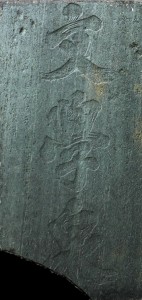 The Spring of the Instructor was once an important source of water in the ancient town of Jingling. Pure and clear, the spring was discovered long ago by a venerated monk, and for hundreds of years thereafter its waters were used to brew tea at the nearby monastery. As the basic medium for making tea, the spring’s sweet water was essential and preferred for its purity, clarity, and taste. According to tradition, the Tang tea master Lu Yü drew water from the spring as a boy. Many sources of fine water were credited to Lu Yü during his lifetime, but the spring at Jingling was plainly identified with his adolescence, giving it precedence above all others in the shaping of his taste and ideas on tea. Lu Yü later used the knowledge he gathered from his early time at the spring to write the Chajing 茶經, the Book of Tea. From the late Tang dynasty through the twentieth century until today, the site of the spring was ornamented with pavilions and halls to commemorate the Book and life of Lu Yü, the Sage of Tea. Continue Reading →
Tsia and Tsiology: A History of the Words
Introduction
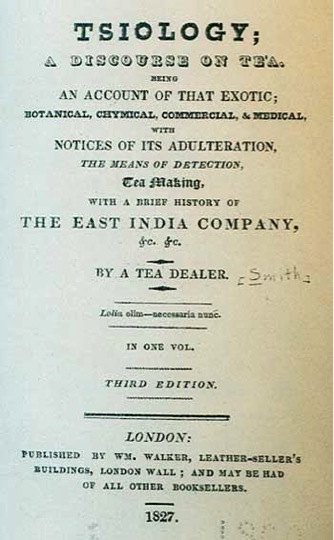 The word tsiology is a nineteenth century expression. Rare and obscure, tsiology was said to mean “a scientific dissertation on tea.”[1] As a term, tsiology was expressly coined in 1826 for a polemical account published that very year in London. In keeping with the expository style of titles of the time, the name of the book ran on at some length: Tsiology: A Discourse on Tea. Being an account of that exotic, botanical, chymical, commercial and medical, with notices of its adulteration, the means of its detection, Tea making, with a brief history of The East India Company, etc. The small, one volume book was written by an English author who anonymously and simply referred to himself as “A Tea Dealer.”[2] In addition to being an exposition on tea, Tsiology was a defense of the East India Company monopoly and a critique of not only escalating government tariffs but also of fraudulent schemes disrupting the domestic tea trade. Tsiology temporarily attracted London readers with its facade of scholarship, the book surviving three editions printed over a year or so.[3] While the book raised several important and timely issues about the British trade, the term tsiology never gained acceptance as an expression of tea, and indeed it all but vanished from literary as well as spoken English. Continue Reading →
Wandering Immortal
壺蘆居士繙譯
Guo Pu of the Eastern Jin
Wandering Immortal
The bustling capital is a pitfall for wayward gentlemen.
The mountain forest is seclusion for hermits.
No need to exalt the vermillion gate;
It is incomparable to embracing Penglai,
Where right from the Source I ladle pure water,
Where from the hills and mountains I gather cinnabar mushrooms.
Spirit Stream conceals me well:
No need to climb the Ladder of Clouds.
Lacquer Garden had Chuangzi;
Master Lai, a reclusive wife.
Advancing ensures seeing the dragon but
Retiring is like a ram butting a fence.
On the high Path, I abandon the swirling dust,
Bidding farewell to Boyi and Shuqi.
Bring in the Wine
壺蘆居士繙譯
Li Bai of the Tang dynasty
Bring in the Wine
Have you not seen the Yellow River waters flowing from Heaven,
Rushing to the sea, never to return?
Have you not seen parents’ sorrow in their white hair?
Once, it was like black silk at dawn, now at sunset it’s like snow.
A life fulfilled must contain happiness:
Never let the golden vessel go empty, just add the moon!
Born with Heaven’s gifts, I must use them;
I’ve scattered thousands in gold and it all returns to me.
Boil the mutton, butcher the ox, all for joy!
Muster a draught of three hundred cups!
Elder Cen and Master Danqiu,
Bring in the wine, the ceaseless cups.
Just one more song for you,
Please just listen closely.
Bells and drums, delicacies and jade? All nothing!
I just want one long binge, not sobriety!
Old sages and worthies? All forgotten!
Only great drunks leave behind their names.
Prince Chen once feasted in the Temple of Tranquil Joy,
Worth tens of thousands, casks of wine indulged every pleasure.
So how dare I say my money is running out?
Go buy more wine and fill our cups.
My fine dappled horse, my precious furs,
Call over the servant boy, exchange them for rare wines.
Together we’ll wash away ten thousand old sorrows.
Excerpt from the Rhapsody on the Capital of Shu
壺蘆居士繙譯
Yang Xiong of the Han dynasty
Excerpt from the Rhapsody on the Capital of Shu
…Thus,
The Five Grains are abundant,
The squashes and gourds, aplenty, and
The many plants yield thatch and hemp.
Everywhere is ginger and gardenia,
Monkshood and great garlic,
Flowering shrubs and wormwood,
Pepper and riverweed.
The sundry gels, pastes, and sweet wines,
All gathered, presented, and stored.
In winter, the bamboo nurtures shoots
To accompany the daily dishes.
The Hundred Flowers burst forth in spring
Filling the air with gentle perfume.
Tendrils and tea, lushly profuse,
Jade green, russet, and celadon,
Glorious as luminous dragon scales,
Spread like rich embroidery and
Vast prospect without end…
Thomas Garway’s Broadsheet Advertisement for Tea, circa 1668
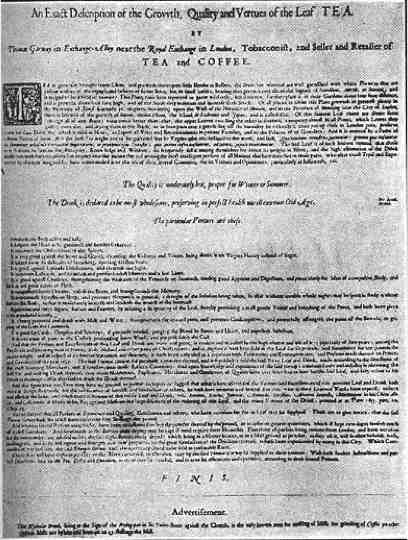 “An Exact Description of the Growth, Quality, and Vertues of the Leaf TEA, by Thomas Garway in Exchange Alley, near the Royal Exchange in London, Tobacconist, and Seller and Retailer of TEA and COFFEE.
Tea is generally brought from China, and groweth there upon little Shrubs or Bushes, the Branches whereof are well garnished with white Flowers that are yellow within, of the bigness and fashion of sweet Brier, but smell unlike, bearing thin green leaves about the bigness of Scordium, Mirtle, or Sumack, and is judged to be a kind of Sumack: This Plant hath been reported to grow wild only, but doth not, for they plant it in their Gardens about four foot distance, and it groweth about four foot high, and of the Seeds they maintain and increase their Stock. Of all places in China this Plant groweth in greatest plenty in the Province of Xemsi, Latitude 36. degrees, bordering upon the West of the Province of Honam, and in the Province of Namking, near the City of Lucheu; there is likewise of the growth of Sinam, Cochin China, the Island de Ladrones and Japan, and is called Cha. Of this famous Leaf there are divers sorts (though all of one shape) some much better than the other, the upper Leaves excelling the other in fineness, a property almost in all Plants, which Leaves they gather every day, and drying them in the shade, or in Iron pans over a gentle fire till the humidity be exhausted, then put up close in Leaden pots, preserve them for their Drink Tea, which is used at Meals, and upon all Visits and Entertainments in private Families, and in the Palaces of Grandees. And it is averred by a Padre of Macao Native of Japan, that the best Tea ought not to be gathered but by Virgins who are destined to this work, and such, Qua nondum Menstrua patiuntur; gemma qua nascuntur in summitate arbuscula servantur Imperatorie, ac pracipuis ejus Dynastis: qua autem infra nascuntur, ad latera, populo conceduntur.[1] The said Leaf is of such known vertues, that those very Nations so famous for Antiquity, Knowledge, and Wisdom, do frequently sell it amongst themselves for twice its weight in Silver, and the high estimation of the Drink made therewith, hath occasioned an inquiry into the nature thereof among the most intelligent persons of all Nations that have travelled in those parts, who, after exact Tryal and Experience by all Wayes imaginable, have commended it to the use of their several Countries, for its Vertues and Operations, particularly as followeth, viz. Continue Reading →
Ascending the White Rabbit Pavilion in Chengdu
Hulu jushi fanyi
Zhang Zai of the Western Jin
Ascending the White Rabbit Pavilion in Chengdu
Corners bind the city’s inner walls,
Wing swept eaves mount storied pagodas.
Rooftops pierce the heavenly clouds,
Tall spires ascend into the Void.
High pavilion, the open crimson door:
The view, an unbroken panorama.
To the west, the river Min and mountain ridges:
Lofty Mount E looms larger than the peaks of Jing and Wu.
Great taro patches cover the land,
Plains and marshes grow grains and greens.
Even when compared to the time of Yao and Tang,
Food is ever abundant.
In myriad small towns,
Crowd the common folk.
The streets, confused, a tangle of fine silk threads;
Roofs and rafters invade the boulevards.
I wish to ask about Master Yang’s abode
And to see the home of the Elder Minister.
Cheng and Zhuo piled up thousands in gold,
As proud and prodigal as the Five Marquises.
They ride marvelous mounts and
Wear jade belts and swords from Wu.
Their bronzes filled with foods of the Four Seasons,
Blending aromas, wonderful and rare.
But truly, I’d rather be in the woods picking autumn oranges
And on the nearby rivers angling for spring fish:
Black fry tastier than fish sauce,
Fruit more luscious than crab dip.
Fragrant, beautiful tea crowns the Six Purities,
Its overflowing flavor spreads through the Nine Regions.
If only life were that peaceful,
This world would hold more pleasure.
The Accomplished Man
Hulu jushi fanyi
Zuo Si of the Jin dynasty
Poem Eight from Eight Poems on History
Flap, flap, a caged bird
Beating wings against four corners.
Aloof, aloof, the backstreet scholar,
A brooding shadow kept to an empty house.
Going out, there is no exit,
Brambles block the way.
Dreams are abandoned,
Like fish out of water.
On the street – no measure of fortune;
At home – not a measure saved.
Constantly belittled by relations,
Day and night neglected by friends.
Su Qin propagandized in the north and
Li Si memorialized in the west, but
Aspiring to glory and splendor, tsk,
Is just carving rotten wood.
Drinking from the river fills the belly,
But one can drink only so much.
A forest nest need perch but on a single branch:
Such is the way of the accomplished man.
Engelbert Kaempfer on Tea and Bodhidharma
The Japanese legend of the discovery of tea by the first Zen Patriarch Bodhidharma graphically detailed the dedication of the master to meditation. According to the story, Bodhidharma, known as Daruma in Japan, practiced a strict regimen of meditation at the Shaolin Temple outside the ancient Chinese capital of Luoyang by sitting in a nearby cave and facing the wall. He meditated in this fashion for many years until one day, without realizing his fatigue, he fell asleep. Angered by his inability to stay awake and concentrate, he ripped out his eyelids and flung them to the ground. Miraculously, the flesh sprouted into tea plants at his feet. Tasting the leaves, he felt refreshed and clear minded and immediately resumed meditation. His habit of tea was passed to his disciples and through them to the whole Buddhist community. Such was the origin of tea explained in Japanese folklore.
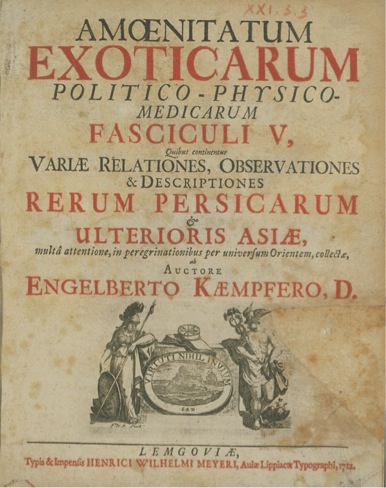 The first ever literary expression of the Bodhidharma tea story appeared to have been written in Latin by the German naturalist and physician Engelbert Kaempfer (1651-1716 A.D.) while serving as surgeon to the Dutch East India Company. Between 1690 and 1692, Kaempfer was stationed at Deshima, the small island connected to the Japanese port of Nagasaki. A gifted botanist and keen observer, he wrote one of the most complete descriptions of tea of the time, noting not only the plant but also its Japanese name, cultivation, harvest, types of tea, preparation, preservation, use, virtues and vices, and implements and utensils for making and serving tea. In 1712, Kaempfer published his study of tea as “Theae Japonensis historia” in the third fascicle of Amoenitatum Exoticarum, otherwise known as Exotic Pleasures, and included the popular image of Bodhidharma depicted crossing the Yangzi River on a reed as well as the legend of the origin of tea. Continue Reading →
Tea and Bodhidharma
The discovery of tea was ever a story of many dimensions, and the telling of the tale depended on the leaf’s use as medicine, food, or drink. Throughout history, tea was intimately related to deities, demi gods, and mortals. In Japan, the monastic use of tea as an aid to meditation was celebrated by linking the plant and its origins to Bodhidharma, the first Patriarch of Zen Buddhism.
Bodhidharma was a Buddhist monk who traveled from India to China around the year 475 of the Common Era. Some thirty five years earlier, he was born a Brahman of the Hindu faith and a prince of the southern Indian kingdom of Pallava. He converted to Buddhism in his youth and was instructed by his teacher to go to China. Arriving by ship on the south China coast, he spent fifteen years traveling to various courts and monasteries, teaching along the way. Sometime around 490, he crossed the river Yangzi and headed north to the capital of Luoyang where he lived until his death in 528. Continue Reading →
Drinking from the Dragon’s Well
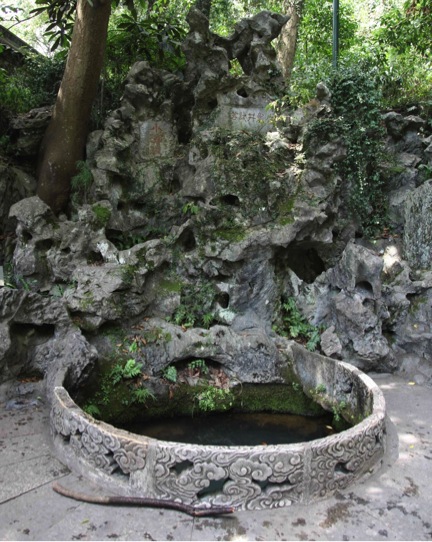 Dragon Well is fed by a clear mountain spring near beautiful West Lake. In ancient times, the spring’s cold, pure waters gathered in a pool known as Longhong that lay sheltered deep within an old forest. Remote and secluded, the pool became the haunt of hermits seeking solitude and tranquility.
According to legend, the pool Longhong was silent and placid, but when agitated, the waters emitted a low, mournful sigh, and a mysterious, undulating, liquid coil snaked along the rippling surface and then slowly disappeared. These strange signs marked the watery lair of the benevolent dragon that protected West Lake and the old city of Hangzhou nearby.
Lured by the weird effluence and its resident spirit, wizards and alchemists swirled the wondrous waters from the “well of the dragon” into their elixirs and potions. Tasting sweet and light, the water from Dragon Well lent its name, Longjing, to the green tea grown in the nearby valleys and terraced hills.
Memories of Pu’er Tea
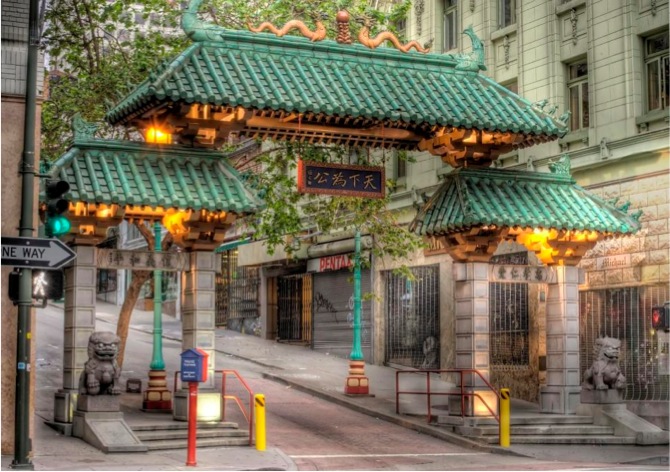 Pu’er cha 普洱茶 is a hot Chinese drink familiar to almost anyone eating in an old Hong Kong style restaurant and drinking its tea. In such a place and in times long past, Pu’er was the only tea of consequence. This was especially true in San Francisco’s Chinatown, which in the early 1950s was packed, cheek by jowl, with dives like the Buddha Lounge and green grocers and a myriad restaurants, big and small.
At the high end of the culinary scale was Kan’s, a posh establishment with a gold and scarlet interior, plush drapes and upholstered chairs, where suave waiters paraded in slicked back hair, starched white shirts, bowties, and black vests, serving exotic bird’s nest soup and sauced sea cucumbers. Kan’s menu raised the bar, attracting well heeled patrons, politicians, and movie stars.
A humbler affair but equally famous, Sam Wo occupied a unique spot on the eat-o-meter. Housed in a narrow space squeezed tightly between two buildings, the sparsely furnished upper floors were reached only by brushing past fiery stoves and wiry cooks wielding cleavers and woks. Sizzling and splattering, the tiny kitchen dished out congee 粥, fen 粉, and noodles 麵, the “three harmonies” for which Sam Wo 三和 was named.
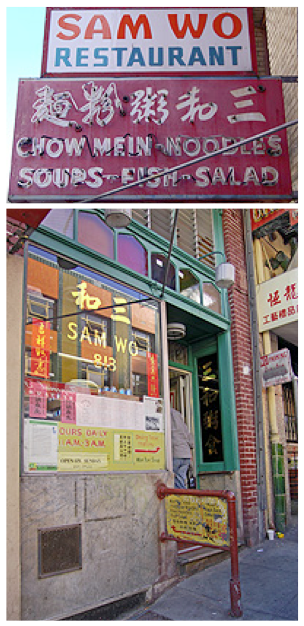 Sam Wo’s questionable charm was perversely enhanced by rickety stools and wobbly tables and a notoriously insolent waiter. Choosing the unlikely name Edsel Ford Fong, he roundly entertained everyone by gruffly abusing each customer while expertly tossing about clattering plates of savory chowmein, bowls of wonton, and mounds of sliced raw fish with slivers of red ginger over crisped noodles.
Regardless of the place chosen – high or low – Kan’s or Edsel’s – once seated, all were welcomed by a steaming pot of tea served out in a small cup as a matter of custom and courtesy, and because a proper meal always began with Pu’er.
On the weekends, Pu’er tea was essential when observing yumcha 飲茶, literally to “drink tea,” an occasion when whole families met for brunch over rounds of dimsum 點心, the nearly endless array of savory fare that was so expensive to create that only restaurants offered it, so dizzyingly rich that it was served just in small portions, and so utterly satisfying that it “dotted the heart.” As each delicious morsel was consumed, empty pots were replenished and cups refilled, the Pu’er sipped slowly to cleanse the palate in anticipation of the lush flavors of the next tempting dish. As plates piled up and bits of gossip flew about the table, drinking Pu’er tea aided digestion, stemmed the tide of triglycerides, and cleared foggy heads. And in those empty moments of soft silence, a sip of Pu’er and a pensive nod helped fill the conversation.
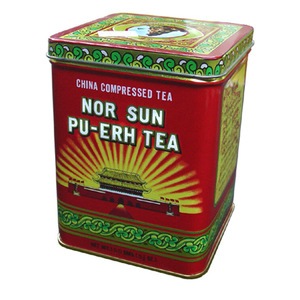
On the way home, a stop at the Chinese grocery store acquired the week’s household quota of loose Pu’er packed in a small square tin. Back at the house, opening the box revealed an inner lid and inside that, a cellophane bag chock full of dark brown leaves mixed with twigs and stems. When opened, the tea filled the nose with the scent of dry wood and dirt.
A heaping tablespoon fed a perpetual Pu’er that filled the old porcelain pot, kept warm in a wicker cozy, the tea shared by young and old throughout the day quenching thirst, refreshing the mind, restoring vigor, and lifting the mood.
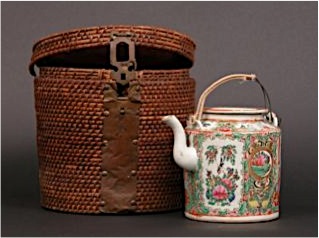
The tea was drunk all year round, but in summer or hot weather dried chrysanthemum blossoms were added for their cooling effect. To treat a cold or for just a treat, children drank Pu’er poured steaming hot over a piece of preserved fruit such as longan, jujube, or lemon peel that flavored the tea. When the tea was finished, the juicy bit was a tasty prize sucked and swallowed. On Chinese holidays, crystallized ginger, sugared coconut and lotus root were traditional favorites for sweetening life and cups of Pu’er.
As with all good things – polished rice, sesame oil, fragrant soy, and fine vinegar – Pu’er tea was indispensable, and its very presence the certain sign of a prospering and stable home.