
Four Scenic Views of Jingling

眠雲臥石
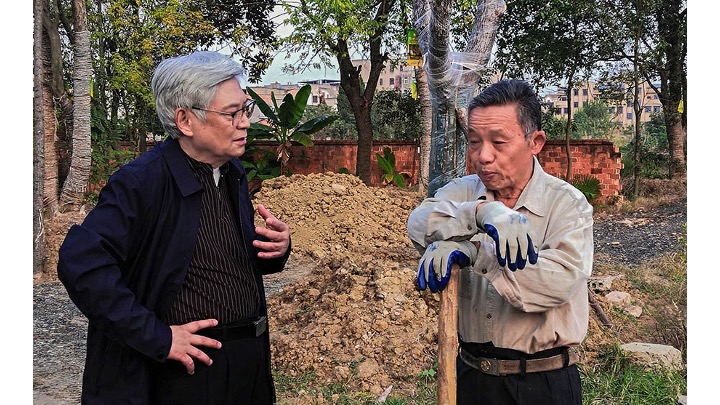
Tong Zhengxiang 童正祥 and Cheng Yuanbin 程遠斌
An essay dedicated to the life and work of Doctor Tong Zhengxiang 童正祥 (1945–2025),
a native son of Old Jingling and eminent scholar on the tea master Lu Yu 陸羽 (circa 733–804),
here engaged with the cultural preservationist and poet Cheng Yuanbin 程遠斌 (1949– )
at the site of the Confucian academy on Mount Huomen.
Four Scenic Views of Jingling
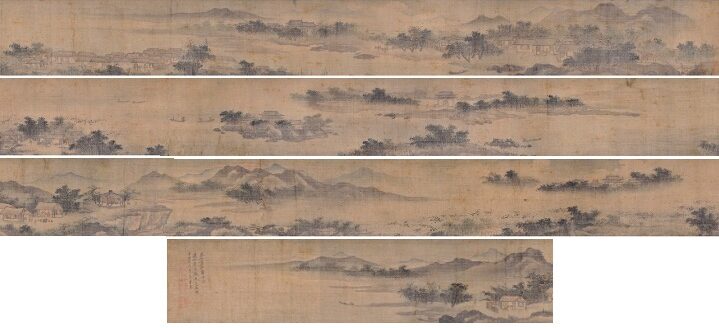
In times past, Jingling 竟陵 was an idyllic place of uncommon beauty and grace. Known as the End of Hills, Jingling spread below the southern foothills of Mount Dahong 大洪山 and across the alluvial plain of Hubei. The town lay just north of the swift waters of the river Han 漢江 that flowed eastward towards Wuhan 武漢 and on through the lower reaches of the Yangzi 揚子江. Jingling was distinguished by Donghu 東湖 and Xihu 西湖, placid twin lakes, east and west, on either side of a town that was further marked with freshwater springs, ponds, and canals. Not far from Jingling, East Ridge 東岡 rose above hamlets and villages scattered among low waterways, marshes, and lakes.
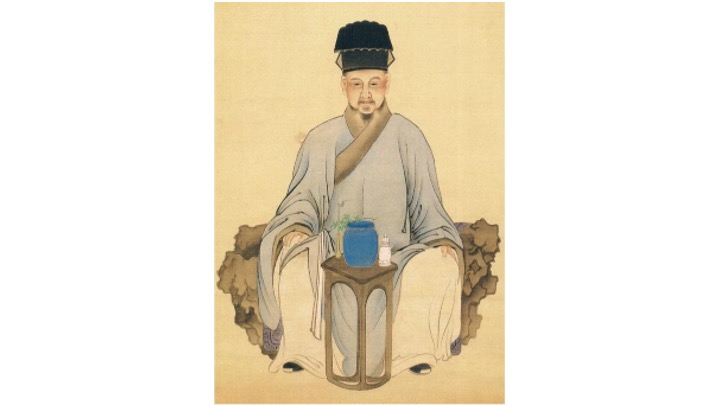
Lu Yu 陸羽
Native Son of Jingling
The Tang tea master Lu Yu 陸羽 (circa 733-804) was among Jingling’s most notable literary figures. A foundling at the age of two, Lu Yu was adopted and raised among the brethren of the Temple of the Hidden Dragon 龍蓋寺, a Buddhist monastery built on an islet near the shallows of Xihu 西湖. Trained as a novitiate, Lu Yu initially learned to read and write from scripture, but later as an adolescent of fourteen, he attended a Confucian academy on nearby Mount Huomen 火門山, returning to Jingling five years later to work on staff of two successive prefectural governors.
In 755, Lu Yu left Jingling to conduct research on tea in the wilds of Bashan Xiachuan 巴山峽川 in the western Shannan 山南道 and Jiannan 劍南道 circuits along the middle stretches of the Yangzi. He returned to Jingling a year later to settle in the nearby Village of East Ridge 東崗村, where he collated his field notes and adopted the alias Master East Ridge 東崗子. Within months of his return, Lu Yu was forced by the AnShi Rebellion to flee Jingling, crossing the Yangzi south to safety, eventually settling in Huzhou 湖洲, where he resided for the rest of his long life.
After Lu Yu published the Book of Tea 茶經 in 780, his literary prominence attracted the attention of the dragon throne, which appointed him to imperial offices and promised a living out of poverty. In response, Lu Yu summarily declined the posts and wrote the poem Lament of Desires, fondly recalling his hometown, where he spent his youth:
I do not desire wine vessels of yellow gold 不羨黃金罍
Nor desire cups of white jade. 不羨白玉杯
I do not desire mornings at court 不羨朝入省
Nor desire evening audiences. 不羨暮入臺
Only one thousand, ten thousand desires 千羨萬羨
For the western waters of the river 西江水
That flow past the walls of Jingling. 曾向竟陵城下來
 Western Gate of Jingling and the Isle of the Hidden Dragon Temple
Seven and a half centuries after Lu Yu left Jingling, the Ming artist Guo Xu 郭詡 (1456–1532) painted Four Scenic Views of Jingling. Dated 1514, the long handscroll depicted a sweeping panorama along the banks of the Han River, extending east to west. The painting was an intimate portrait of Jingling, highlighting its most important and culturally significant places of the middle Ming period. Inscriptions by the artist divided the scroll, identifying four scenes in succession as Stone Lake at East Ridge, Donggang shihu 東岡石湖; City at the End of Hills, Jingling cheng 竟陵城; Villa on East Lake, Donghu bieye 東湖別業; and the Mengye Academy, Mengye shuyuan 夢野書院.
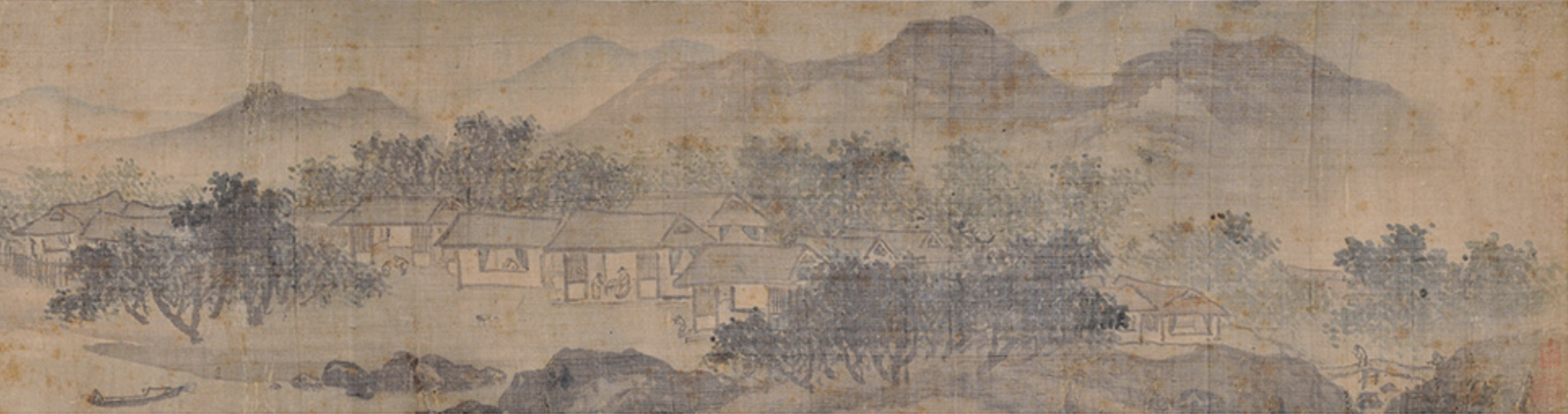
Stone Lake at East Ridge, East of Jingling
Historically, Jingling fostered literary and academic talents such as Lu Yu and the celebrated Tang poet Pi Rixiu 皮日休 (circa 834–883). During the Ming period, the nearby neighborhoods of East Ridge produced the brilliant scholars Ren Hengtai 任亨泰 (js 1388) and Lu Duo 魯鐸 (js 1502, 1461–1527), who achieved high academic and ministerial posts, spawning the quip, “Two Ministers, One Village Lane.” The accomplished Ren Hengtai and Lu Duo were sources of local pride and personages reflective of the high cultural and literary traditions of Jingling and East Ridge.
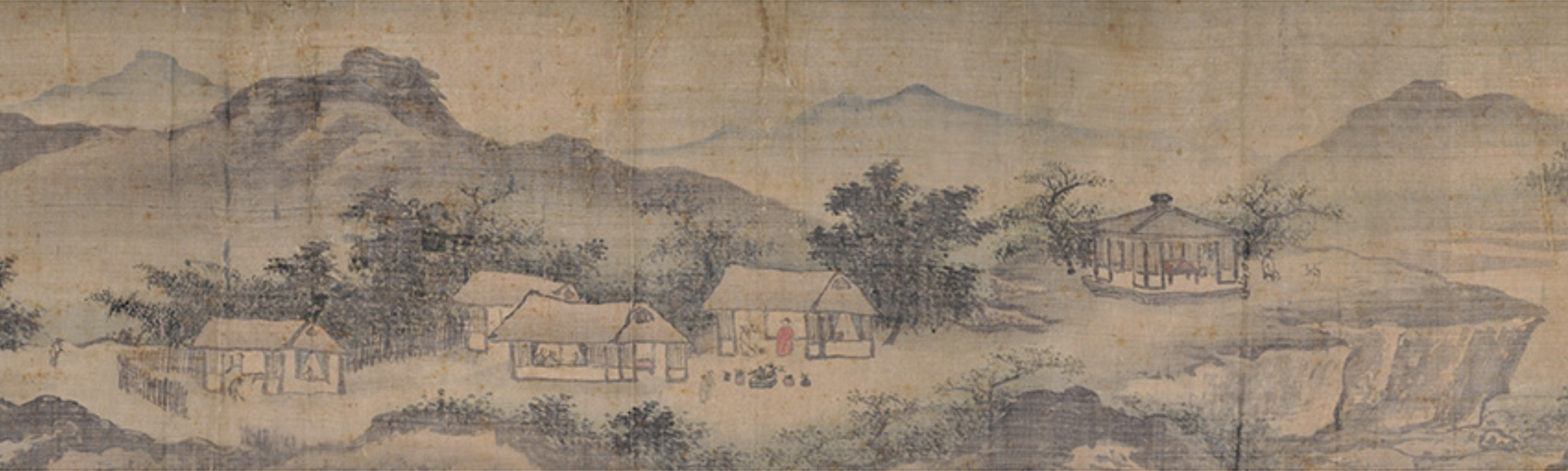
Mengye Academy, West Lake, Jingling
Lu Duo 魯鐸 was born amongst the hamlets and wetlands at Stone Lake just north of East Ridge Village, where the Lu clan had lived for generations. When young, Lu Duo was bookish such that when he sat for the high examinations, he placed first and second, winning imperial distinctions and coveted palace offices. But although he later headed ambassadorial delegations, directed ministries, and held chancellorships in the Ming capitals of Nanjing and Beijing, Lu Duo was known as a recluse. Indeed, he took the name Hermit of Donggang 東岡居士 to emphasize his devotion to eremitism. In a poem among his collected writings, Literary Anthology of Master Lu Wenke 魯文恪公文集, Lu Duo wrote fondly of his early days, drifting alone on Stone Lake:
While Chatting Aboard a Boat, A Brief Poem 舟聊短吟
West wind rippling lake waters, traces of autumn. 西風湖水漾秋痕
A short coat, a tattered book, door shut for the day. 短褐殘編日閉門
Suddenly seeing the bright moon rise above the river town, 忽見江城上明月
Rustic boat and village wine hail the dusk. 野船村酒弄黄昏
Lu Duo’s scholastic success over-rode his reclusive nature, propelling him to high ministerial office. Sometime during the first decade of his palace tenure, Lu Duo established the Mengye shuyuan 夢野書院 or the Academy of the Wilderness of Dreams, a school in Jingling named after the vast wetlands of Yunmengze 雲夢澤, the Marsh of Cloudy Dreams that once spread over the Jianghan Plain. After twenty-two years in office, Lu Duo retired, returning home to Jingling to personally oversee the Academy. As a poet, Lu Duo was a prominent member of the Chaling shipai 茶陵詩派, Tea Hill School of Poetry. Championed by the Grand Secretary Li Dongyang 李東陽 (1447-1516), whose ancestors hailed from Chaling 茶陵, Hunan, the Tea Hill School and its members strove for poetic language that was fresh, natural, elegant, and fluid. When Lu Duo inaugurated the Academy of the Wilderness of Dreams, Li Dongyang, who was also a famous calligrapher, inscribed the placard over the main hall of the school. On his death at the age of sixty-six, Lu Duo was honored by the throne with the posthumous elevation to Vice Minister of Rites and awarded the title Wenke 文恪, Elegant, Scrupulous, and Respectful.
Artist: Guo Xu 郭詡 (1456–1532)
China: Ming dynasty (1368–1644)
Title: Prospects of Spring, Chunwang juan 春望卷, 1514
Handscroll: ink and color on silk
Measurements: 31 centimeters x 975 centimeters
Collection of the Wuhan Museum, Hubei
A National Treasure of the First Order, Guojia yiji wenwu 國家一級文物
Inscriptions:
I. Stone Lake at East Ridge, Donggang shihu 東岡石湖
II. City at the End of Hills, Jingling cheng 竟陵城
III. Villa on East Lake, Donghu bieye東湖別業
IV. Academy of the Wilderness of Dreams, Mengye shuyuan 夢野書院
V. Guo Xu, Qingkuang of Taihe, painted Propects of Spring for Chancellor Master Lu Duo of Lianbei in the jiaxu year of the Zhengde reign, Taihe Qingkuang Guo Xu wei Lianbei Lu Duo Sicheng xiangsheng xie shi Zhengde jiaxu hua Chunwang juan 泰和清狂郭詡為蓮北魯鐸司成先生寫時正德甲戌畫春望卷
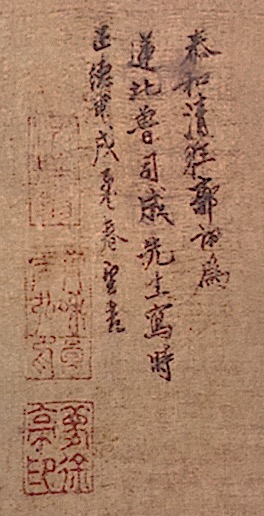
Artist’s Inscription and Seals
Artist’s Seals:
I/1
Relief/square:illegible
I/2-3
illegible
II/1
Relief/rectangle: Kuangweng 狂翁 (Elder Wild Man)
II/2
Relief/rectangle: Dahe Guo Renhong yin 大和郭仁弘印 (seal of Guo Renhong of Dahe)
II/3
Relief/rectangle: Mengxu ting yin 夢徐亭印 (seal of the Mengxu Pavilion)
Notes
Jingling 竟陵 is the old name of the present city of Tianmen 天門, Hubei. The site of the Confucian academy at Mount Tianmen 天門山, formerly known as Mount Huomen 火門山, is about thirteen miles northwest of Tianmen City. East Ridge or Donggang 東崗 is about twenty-one miles southeast of Tianmen City.
Guo Xu, Lu Duo, and Li Dongyang were artistically related. Li Dongyang was a patron of Guo Xu, and Li was the leader of the Tea Hill School of poetry of which Lu Duo was a member. Lu Duo may well have commissioned Guo Xu to paint the handscroll of Jingling.
The Four Scenic Views of Jingling was also known as the Landscapes of Jingling (Jingling shanshui tu 竟陵山水圖) and the Four Scenes of Jingling (Jingling sijing tu 竟陵四景圖). According to the artist’s inscription, the painting was entitled as the “handscroll Prospects of Spring (Chunwang juan 春望卷).”
Dr. Tong Zhengxiang was instrumental in identifying the Four Scenic Views of Jingling handscroll painting as an important cultural property. Tong, who was an avid philatelist, promoted the artwork by initiating the movement for the People’s Republic of China postal service to issue the painting’s image as a set of postage stamps. Tong also supported the reproduction of the painting in other media and formats, including a full set of postcards.
Tong Zhengxiang interpreted the inscribed date Zhengde jiaxu hua chunwang 正德甲戌畫春望 as “the fifteenth day of the first lunar month of the ninth year of the Zhengde era.”